Brian
Mork
Intrepid Creativity (Increa) TM,SM
© 2004-2023 by Brian Mork
 Surplus
Ops & Reverse Engineering - This entails
scrounging, rebuilding,
and generally doing better for fewer dollars what others pay big bucks
for. Many times, this includes dissecting a successful item,
and
learning how they did it. I enjoy seeing
value where others
don't. I put more time into projects, but my knowledge, opinions, and
insights
become experience based rather
than sterile book knowledge.
Surplus
Ops & Reverse Engineering - This entails
scrounging, rebuilding,
and generally doing better for fewer dollars what others pay big bucks
for. Many times, this includes dissecting a successful item,
and
learning how they did it. I enjoy seeing
value where others
don't. I put more time into projects, but my knowledge, opinions, and
insights
become experience based rather
than sterile book knowledge.
Book learning tends to sort knowledge into bins: product
packaging,
analog
design, sensors, digital design, RF, ergometrics, machining, software,
operations, etc. An actual study piece rarely draws the line
where
one stops and the other starts. Reverse engineering entire
packages
gives robust, operational skills across many disciplines. I
appreciate
the spirit of the Midnight Engineering magazine (no longer available
through the original link at Midnight
Engineering. In it's place, a related conference
lives on, called EntConnect.
Web
page publication alternatives seem to have stalled.
Back in 1992, I paid for a life-time subscription to Nuts
&
Volts Magazine, and it is something I continue to value. Through the years, they have paid me a stipend
for authoring original articles. I bid on government
surplus
goodies, and pick up all sorts weird stuff for decent prices.
I repair
what is repairable, sell some, and tear the rest apart for educational
value.
At different times, my interests branch out to
contract
software and hardware engineering, and technical writing.
Check out
the following:
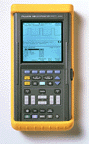 Measurement,
Instrumentation & Display of Information -
Sometimes, older,
analog instruments obtain better information from the world around us
than
all the new, automated tools. I appreciate both. I collect classic
instruments
capable of measuring in orthogonal domains, and tools to process the
information.
I appreciate slide
rules as well as my more modern HP-48.
Even my Palm Pilot can be an practical
data
acquisition tool. If you're familiar with algorithms to
generate
nomographs,
please e-mail me. What do you do with information after collecting it?
Visual
Display of Quantitative Information by Edward Tufte
gives a clue.
If you're interested, take a look at my visual representation of GPS
position wander with Selective Availability turned on, or the
power
output of my gasoline powered electricity generator.
Measurement,
Instrumentation & Display of Information -
Sometimes, older,
analog instruments obtain better information from the world around us
than
all the new, automated tools. I appreciate both. I collect classic
instruments
capable of measuring in orthogonal domains, and tools to process the
information.
I appreciate slide
rules as well as my more modern HP-48.
Even my Palm Pilot can be an practical
data
acquisition tool. If you're familiar with algorithms to
generate
nomographs,
please e-mail me. What do you do with information after collecting it?
Visual
Display of Quantitative Information by Edward Tufte
gives a clue.
If you're interested, take a look at my visual representation of GPS
position wander with Selective Availability turned on, or the
power
output of my gasoline powered electricity generator.
This page is maintained by Brian Mork, owner &
operator of IncreaTM
// It was last modified May 2023. Suggestions for changes and
comments
are always welcome. The easiest way is to contact me via e-mail.